AI Merging with AR/VR — The Intelligent Metaverse
Introduction to the Intelligent Metaverse
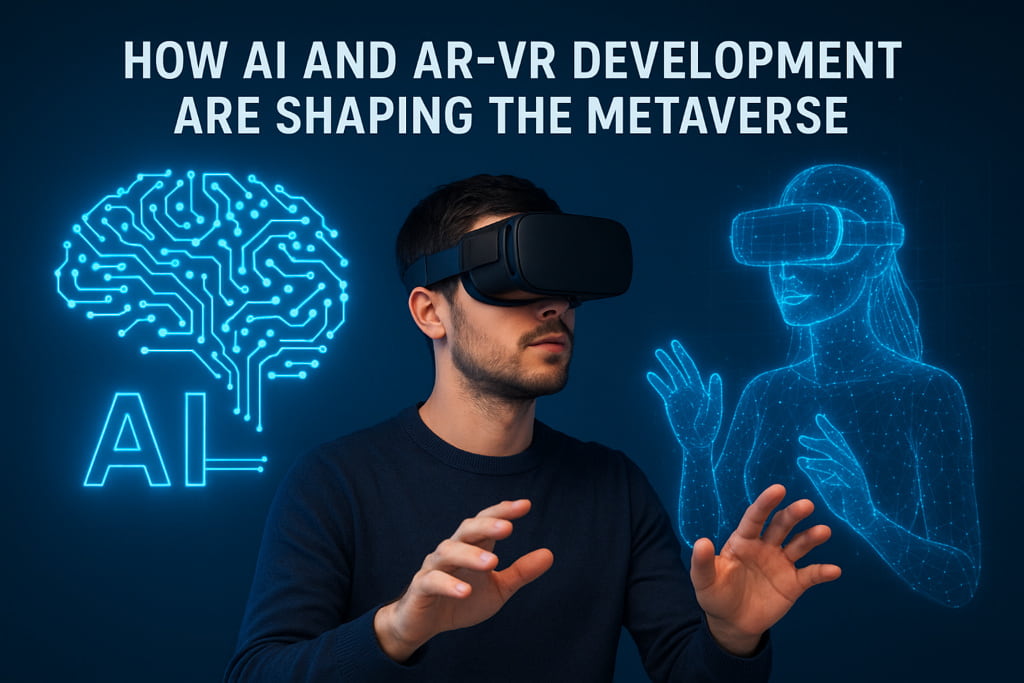
Imagine stepping into a digital world that doesn’t just look real—but thinks, learns, and responds to you like a living organism. That’s exactly what happens when Artificial Intelligence (AI) merges with Augmented Reality (AR) and Virtual Reality (VR). This fusion is giving birth to what many call the Intelligent Metaverse—a persistent, immersive universe that adapts to human behavior in real time. Not science fiction anymore, right?
Understanding the Core Technologies
What Is Artificial Intelligence (AI)?
AI is the brain behind the operation. It’s the technology that allows machines to learn from data, recognize patterns, understand language, and make decisions. In the metaverse, AI acts like an invisible conductor, orchestrating interactions, environments, and experiences seamlessly.
What Are AR and VR?
Augmented Reality overlays digital elements onto the real world—think Snapchat filters or navigation arrows on your windshield. Virtual Reality, on the other hand, immerses you completely in a simulated environment using headsets and sensors.
Key Differences Between AR and VR
AR enhances reality; VR replaces it. When AI joins the party, both become smarter, more responsive, and far more personal.
Why AI + AR/VR Is a Game Changer
From Static Worlds to Intelligent Experiences
Without AI, AR/VR environments are like movie sets—beautiful but static. Add AI, and suddenly the world reacts. Objects respond to gestures, characters remember conversations, and environments evolve based on your actions.
Real-Time Personalization
Ever felt like Netflix knows what you want to watch? Now imagine that level of personalization inside a 3D world. AI tracks preferences, behaviors, and context to tailor experiences on the fly.
How AI Enhances AR Experiences
Computer Vision and Object Recognition
AI-powered computer vision allows AR systems to recognize objects, faces, and spaces in real time. That’s how your phone knows where to place that virtual couch in your living room—without knocking over the coffee table.
Context-Aware Augmentations
AI understands where you are and what you’re doing, enabling AR overlays that actually make sense. Walking through a museum? AI knows what you’re looking at and serves relevant information instantly.
How AI Powers Smarter Virtual Reality
Intelligent NPCs and Avatars
Gone are the days of robotic, repetitive NPCs. AI-driven characters can hold conversations, show emotions, and even surprise you. They feel less like code and more like digital beings.
Adaptive Virtual Environments
Emotion and Behavior Detection
Using voice analysis, gestures, and biometrics, AI can detect how you’re feeling. Stressed? The VR environment might calm down. Bored? Things get more exciting. It’s like the world has empathy.
The Rise of the Intelligent Metaverse
Defining the Intelligent Metaverse
The Intelligent Metaverse is not just immersive—it’s cognitive. It learns from users, predicts needs, and evolves continuously. Think of it as a living digital ecosystem rather than a fixed platform.
Digital Twins and AI-Driven Worlds
AI enables digital twins—virtual replicas of real-world objects, cities, or even people. These twins can simulate scenarios, test outcomes, and optimize decisions in real time.
Use Cases Across Industries
Gaming and Entertainment
AI-driven AR/VR games adapt difficulty, storylines, and characters based on player behavior. Every playthrough becomes unique—like a personalized adventure novel.
Education and Training
From virtual classrooms to AI tutors, learning becomes interactive and adaptive. Mistakes aren’t failures—they’re data points for AI to adjust the lesson.
Healthcare and Therapy
AI-powered VR is being used for pain management, phobia treatment, and surgical training. It’s safer, scalable, and surprisingly effective.
Retail and E-Commerce
Try before you buy—virtually. AI understands your style, AR shows products in your space, and VR stores feel almost… human.
AI Avatars, Identity, and Social Presence
AI-driven avatars mirror expressions, tone, and even personality traits. In the Intelligent Metaverse, your digital self becomes an extension of who you are—not just a cartoon.
Ethical, Privacy, and Security Challenges
Data Privacy in Immersive Worlds
AR/VR collects a lot of data—eye movements, gestures, emotions. AI needs this data, but protecting user privacy is non-negotiable.
Bias, Transparency, and Trust
If AI learns from biased data, the metaverse reflects those biases. Building transparent, ethical AI is critical to a fair digital future.
The Role of Generative AI in the Metaverse
Generative AI creates worlds, characters, music, and stories on demand. Say what you want, and the metaverse builds it—like dreaming out loud.
Future Trends and What Comes Next
Brain-Computer Interfaces and Spatial AI
The next frontier? Controlling virtual worlds with thought alone. Combined with spatial AI, the line between physical and digital will blur even further.
Conclusion: A Smarter Digital Reality
The fusion of AI with AR and VR is more than a technological upgrade—it’s a paradigm shift. The Intelligent Metaverse promises experiences that are adaptive, emotional, and deeply human. As this digital universe grows smarter, the real question isn’t if we’ll live in it—but how responsibly we’ll build it.
FAQs
1. What makes the metaverse “intelligent”?
AI enables learning, adaptation, personalization, and real-time decision-making within AR/VR environments.
2. Is the Intelligent Metaverse already here?
Parts of it exist today, but the fully realized version is still evolving.
3. How does AI improve user experience in AR/VR?
Through personalization, emotion recognition, intelligent avatars, and adaptive environments.
4. Are there privacy risks in AI-driven AR/VR?
Yes, immersive data collection raises concerns, making ethical AI and strong security essential.
5. Which industries will benefit most from the Intelligent Metaverse?
Gaming, education, healthcare, retail, and enterprise training are leading adopters.