How to Design Software for Millions of Users
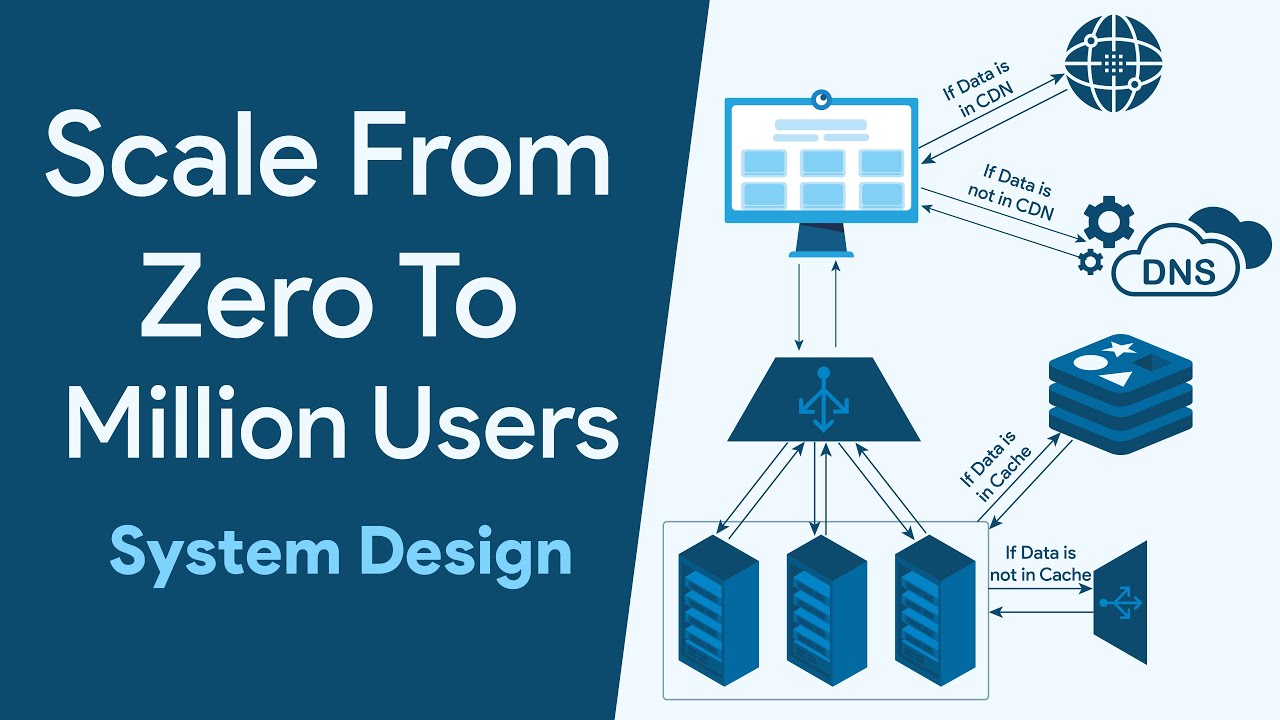
Building software for a few hundred users is one thing. Building software that can reliably serve millions is a completely different challenge. At small scale, you can often get away with simple architecture, a single database, basic monitoring, and straightforward application logic. As the user base grows, however, every architectural decision starts to matter. A database query that takes 50 milliseconds for a small application can become a serious bottleneck when thousands of requests arrive every second.Designing software for millions of users does not simply mean buying bigger servers. It means creating a system that can handle increasing traffic, large amounts of data, unexpected failures, security threats, and rapidly changing workloads without collapsing. The goal is to build an architecture that can grow with demand while remaining reliable, maintainable, and cost-effective.
Why Designing for Millions of Users Is Different
When an application reaches millions of users, scale affects almost every layer of the system. Web servers, APIs, databases, storage, networking, authentication, caching, queues, and monitoring all become important.Consider a simple e-commerce application. If 100 people are browsing products at the same time, a basic application may work perfectly. Now imagine millions of customers browsing products during a major sale. Suddenly, product searches increase dramatically, checkout requests arrive simultaneously, databases receive thousands of writes, and payment-related services become critical dependencies.At this scale, small inefficiencies become expensive. A poorly optimized database query might consume significant computing resources. A missing cache layer might send unnecessary requests to the database. A single-server architecture might become a single point of failure.This is why scalability should be treated as a design requirement from the beginning rather than something added after the application becomes popular.
Start With Scalability as a Core Requirement
Before choosing technologies, estimate what the system actually needs to handle. “Millions of users” is not a precise technical requirement. Ten million users who log in once a month create a very different workload from one million users who interact with an application every few minutes.Start by estimating metrics such as daily active users, peak concurrent users, requests per second, data growth, average response time, and peak traffic.For example, if an application expects 10 million registered users but only 500,000 are active each day, designing around 10 million simultaneous connections would be unnecessary. Instead, architecture should focus on realistic usage patterns and peak conditions.
Define Your Expected User Load
Create realistic capacity targets before development begins. Ask questions such as: How many requests should the system support per second? What is the expected peak traffic? How much data will users generate every day? What response time is acceptable? How quickly should the system recover from failures?These numbers provide a foundation for architectural decisions. Without them, scalability discussions can become guesswork.
Plan for Traffic Growth
Good architecture should provide room for growth. You do not necessarily need infrastructure capable of supporting 100 million users on day one. Instead, design the system so additional resources can be added without rewriting the entire application.This approach prevents both underengineering and unnecessary complexity.
Build a Scalable Software Architecture
Architecture determines how easily your application can grow. A scalable architecture separates responsibilities and allows individual components to scale according to demand.A typical large-scale system may contain a client application, API layer, application servers, caching layer, databases, object storage, message queues, and external services.The exact architecture depends on the product, but the underlying principle remains the same: avoid making every part of the system depend on one resource or one machine.
Monolithic vs. Distributed Architecture
A monolithic application is not automatically unsuitable for large-scale systems. A well-designed monolith can support substantial traffic when it is optimized and deployed across multiple instances.The problem appears when the application becomes difficult to scale or change independently. If one component requires significantly more resources than another, scaling the entire application may waste infrastructure.Distributed architectures allow different services to scale independently, but they also introduce complexity. Communication between services, data consistency, deployment, monitoring, and debugging become more challenging.
When to Introduce Microservices
Microservices can be useful when independent scalability, team ownership, or deployment requirements justify them. They should not be introduced simply because an application is expected to become large.Start with clear service boundaries and introduce additional services when there is a practical reason. Unnecessary microservices can turn a manageable application into a complicated network of dependencies.
Design for Horizontal Scaling
One of the most important principles of large-scale software is horizontal scaling. Instead of continuously making one server more powerful, horizontal scaling adds more servers or application instances.Imagine one application server can handle 1,000 requests per second. If traffic grows beyond that capacity, you can add additional servers and distribute traffic between them.
Vertical vs. Horizontal Scaling
Vertical scaling means increasing the CPU, memory, storage, or other resources of an existing machine. It is simple, but every server eventually reaches a physical or economic limit.Horizontal scaling means adding more machines or instances. It generally provides greater flexibility because capacity can grow incrementally.For applications serving millions of users, horizontal scaling is often an important part of the architecture.
Load Balancing
Load balancers distribute incoming traffic across available application servers. They can also detect unhealthy instances and prevent new requests from being sent to them.This improves both performance and availability. If one application server fails, other instances can continue handling requests.Stateless application servers make this approach easier because any healthy instance can process a request without relying on local session data.
Build a High-Performance Database Layer
Databases frequently become one of the biggest scalability challenges. As users increase, the number of reads and writes can grow dramatically.The solution is not always to replace the database. Often, better data modeling, indexing, caching, replication, and query optimization can dramatically improve performance.
Database Indexing
Indexes help databases locate information without scanning entire tables. Proper indexing can significantly reduce query execution time.However, indexes are not free. They consume storage and can increase the cost of write operations. Indexes should therefore be based on actual query patterns rather than added randomly.
Read Replicas
Applications with many more reads than writes can use read replicas. Data is replicated from the primary database to additional database instances, allowing some read traffic to be distributed across them.This can reduce pressure on the primary database and increase read capacity.
Database Sharding
When a single database becomes too large or receives too much traffic, sharding can divide data across multiple database instances.For example, users could be distributed based on user ID ranges or geographic regions. Each database handles only a portion of the overall dataset.Sharding can provide significant scalability, but it introduces complexity around queries, transactions, rebalancing, and data management. It should therefore be adopted when simpler scaling techniques are no longer sufficient.
Use Caching to Reduce System Load
Why repeatedly calculate or retrieve the same information when it can be reused? Caching stores frequently accessed data closer to the application so repeated requests can be served faster.Product catalogs, configuration data, user preferences, session information, and frequently requested API responses are common caching candidates.
Application-Level Caching
Applications can cache frequently accessed information in memory. This can dramatically reduce repeated database queries.However, developers need to consider cache expiration and invalidation. Outdated information can cause incorrect results, which is why cache strategy should be designed alongside data requirements.
Distributed Caching
Large-scale applications often use distributed caching systems so multiple application servers can access the same cached data.A distributed cache can reduce database traffic and improve response times, particularly for workloads involving repeated reads.
Design Reliable APIs
APIs are often the central communication layer between applications, services, and clients. Poor API design can create unnecessary traffic and increase infrastructure costs.APIs should return only the data clients actually need whenever possible. Large responses increase bandwidth consumption and processing time. Pagination is particularly important for large datasets. Instead of returning thousands of records in one request, return manageable pages or use cursor-based pagination for high-volume data.
API Rate LimitingRate
limiting controls how many requests a client can make within a specific period. It protects services from accidental overload, abusive traffic, and sudden request spikes.Rate limits can also be different for different users or subscription levels depending on the product's
requirements
Design for Failure
At large scale, failures are not unusual events. Servers fail. Networks experience problems. Databases become unavailable. Third-party services experience outages.The goal is not to build a system that never fails. The goal is to build a system that can continue operating when individual components fail.
Improve Security at Scale
More users also mean a larger security surface. Authentication, authorization, encryption, input validation, secrets management, logging, and vulnerability management become essential.Security should be built into the architecture instead of added after the application is already deployed.Rate limiting can reduce abuse. Strong authentication can protect accounts. Encryption can protect sensitive information in transit and at rest. Access controls should ensure that users and services can access only the resources they actually need.
Conclusion
Designing software for millions of users requires a mindset shift. Instead of asking, “Can this application work?” teams need to ask, “How will this application behave when demand increases by 10x or 100x?”The strongest scalable systems are built around horizontal scaling, efficient databases, caching, reliable APIs, asynchronous processing, fault tolerance, security, observability, and continuous performance testing.You do not need to build the most complicated architecture from day one. Start with clear requirements, measure real workloads, remove bottlenecks, and introduce complexity only when the product actually needs it.Scalability is ultimately a journey. The best architecture is not necessarily the most sophisticated one—it is the architecture that can evolve as your users, data, traffic, and business requirements grow.
FAQs
1. What does it mean to design software for millions of users?
It means creating an application architecture capable of handling large traffic volumes, growing datasets, concurrent users, failures, and security requirements while maintaining acceptable performance and reliability.
2. Should every application use microservices to support millions of users?
No. A well-designed monolithic application can scale significantly. Microservices are useful when independent deployment, ownership, or scaling requirements justify their additional complexity.
3. How can a database handle millions of users?
Techniques such as proper indexing, query optimization, caching, read replicas, partitioning, and eventually sharding can help databases handle increasing workloads.
4. Why is caching important for scalable software?
Caching allows frequently requested information to be served without repeatedly querying slower underlying systems. This can reduce database load and improve response times.
5. How do you test software for millions of users?
Use load testing, stress testing, capacity testing, and failure testing to simulate realistic traffic patterns and identify bottlenecks before production.